

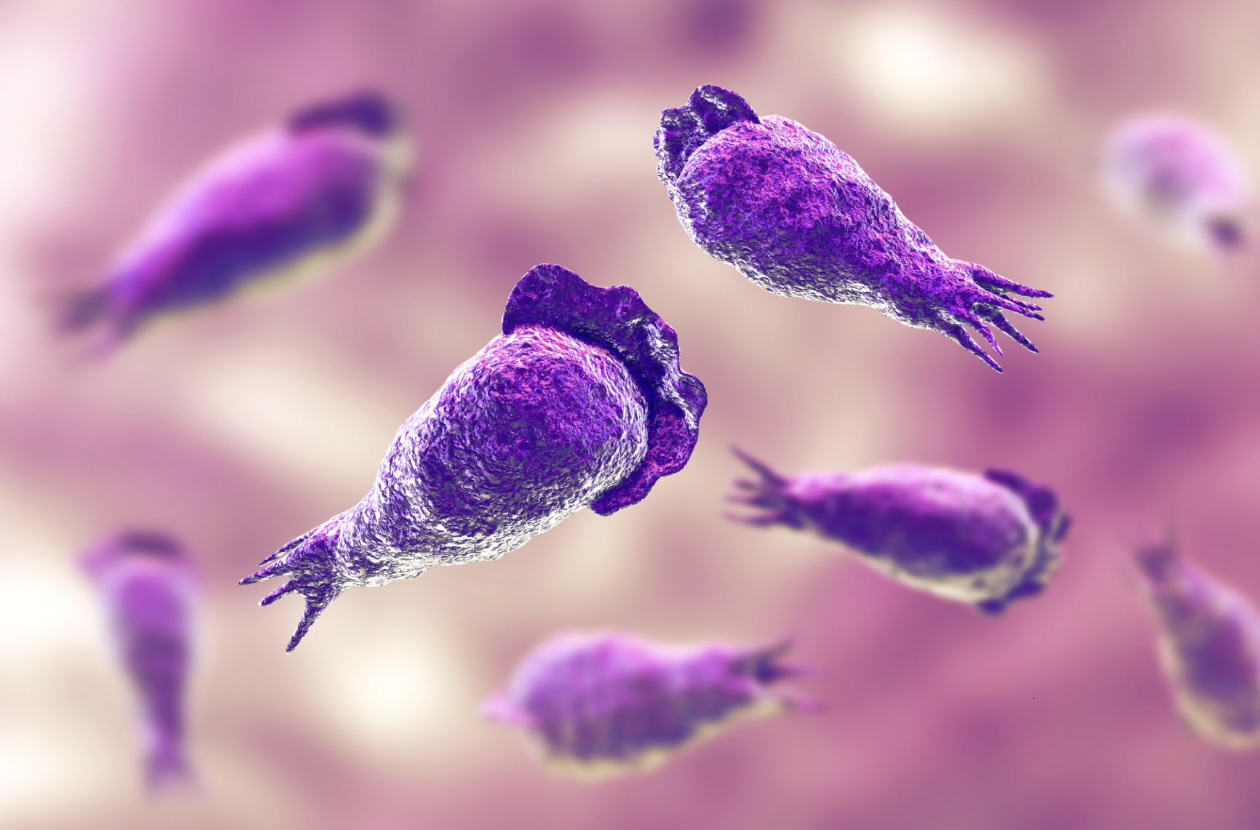
The single-celled organism commonly known as the “brain-eating amoeba”—Naegleria fowleri—normally lives an innocuous life, scavenging bacteria in the warm sediment of freshwater lakes and ponds. Yet, when forced into nasal passages, it can complete a devastating journey into the human central nervous system.
New research published in the Proceedings of the National Academy of Sciences sheds light on the mechanical behaviors that make this migration possible:
- Relentless Forward Drive: In lab experiments led by cell biologist Lillian Fritz-Laylin at the University of Massachusetts Amherst, researchers tested Naegleria amoebas in microscopic artificial channels. Once inside these tight spaces, the organisms behaved “like robots,” moving continuously forward with almost zero tendency to turn back.
- Accelerating Under Confinement: The amoebas readily squeezed into pathways narrower than their own cell bodies. When enclosed in channels, their crawling speed surged—moving up to twice as fast as amoebas roaming freely in open areas.
- Evolutionary Accident: These exploratory traits likely evolved to help the amoebas hunt bacteria through dense pond sediment. However, when warm water forces them up a human nasal cavity, those same navigational habits inadvertently drive them along the olfactory nerve directly into brain tissue.
While Naegleria fowleri infections—known medically as primary amebic meningoencephalitis (PAM)—are rare (fewer than 10 cases annually in the United States), they carry a fatality rate greater than 97%.
How to Protect Yourself from Naegleria fowleri
Because Naegleria fowleri only causes infection when forced up the nose—it cannot infect you by being swallowed or via unbroken skin—prevention focuses on keeping water out of your nasal passages:
1. Control Water Entry While Swimming
- Pinch your nose or wear a nose clip: Use a tight nose plug or hold your nose shut when jumping, diving, or splashing into warm freshwater bodies.
- Keep your head elevated: Avoid submerging your head entirely in warm lakes, rivers, hot springs, or untreated geothermal pools.
- Avoid stirring up sediment: The amoebas primarily dwell in bottom mud and silt; avoid digging or kicking up sediment in shallow, warm water.
2. Practice Safe Nasal and Sinus Rinsing
A notable portion of non-swimming infections occur through neti pots, nasal irrigation bottles, or religious ritual ablutions using tap water.
- Never use raw tap water: Municipal or well tap water is safe to drink, but it is not sterile and can harbor low levels of amoebas.
- Only use safe water: For any nasal rinsing device, use only:
- Distilled or sterile water (clearly labeled on the bottle).
- Boiled water (boiled vigorously for at least 1 minute, then allowed to cool).
- Filtered water using filters labeled NSF 53, NSF 58, or with an absolute pore size of 1 micron or smaller.
- Disinfect irrigation gear: Wash and thoroughly air-dry neti pots and bulb syringes after every use.
3. Maintain Pools and Spas Properly
- Ensure private pools, hot tubs, and splash pads are properly chlorinated and filtered, as Naegleria fowleri cannot survive in adequately disinfected and monitored water systems.
A Naegleria fowleri infection leads to primary amebic meningoencephalitis (PAM), a rapid and aggressive central nervous system infection. In its earliest hours, it closely mimics common viral illnesses or bacterial meningitis, which often complicates early diagnosis.
Early Symptoms (Stage 1)
Initial symptoms usually emerge about 5 days after exposure (with a documented range of 1 to 12 days). The onset is sudden and typically includes:
- Severe frontal or bitemporal headache: Often described as intense and throbbing.
- High fever: Sudden, spiking body temperature.
- Nausea and projectile vomiting: Frequently accompanying the severe headache.
- Olfactory alterations: In rare cases, patients experience a altered sense of smell (parosmia) or taste (ageusia), reflecting early inflammation of the olfactory bulbs where the amoeba enters.
Progression and Later Symptoms (Stage 2)
Because the amoeba destroys brain tissue and triggers acute swelling (cerebral edema), the infection accelerates quickly within 24 to 48 hours of initial symptoms:
- Stiff neck (meningismus): Pain and inability to flex the chin toward the chest.
- Photophobia: Extreme sensitivity to light.
- Neurological decline: Confusion, delirium, lethargy, and lack of attention to surroundings.
- Focal neurological deficits: Loss of balance, cranial nerve palsies, and ataxia.
- Seizures and hallucinations: As swelling increases intracranial pressure.
Clinical Timeline
| Phase | Timing Post-Exposure | Key Milestones & Manifestations |
| Incubation | Days 1–5 (Range: 1–12 days) | Asymptomatic; amoeba ascends through the cribriform plate via the olfactory nerve fibers. |
| Symptom Onset | Days 5–6 | Sudden onset of severe headache, high fever, and vomiting (often mistaken for flu or bacterial meningitis). |
| Neurological Decline | Days 6–8 | Rapid onset of stiff neck, confusion, altered mental state, and seizures due to brain tissue necrosis. |
| Terminal Phase | Days 7–10 (Median: ~5 days after onset) | Herniation caused by cerebral edema; progression to coma and death (fatality rate >97%). |
Critical Note: If sudden high fever, stiff neck, and severe headache develop within two weeks of swimming in warm freshwater or performing nasal irrigation, seek immediate emergency medical care and explicitly inform the medical team of the recent freshwater exposure. Rapid administration of targeted antiamoebic therapies (such as miltefosine, amphotericin B, and azole antifungals, alongside therapeutic hypothermia) offers the only viable window for survival.