

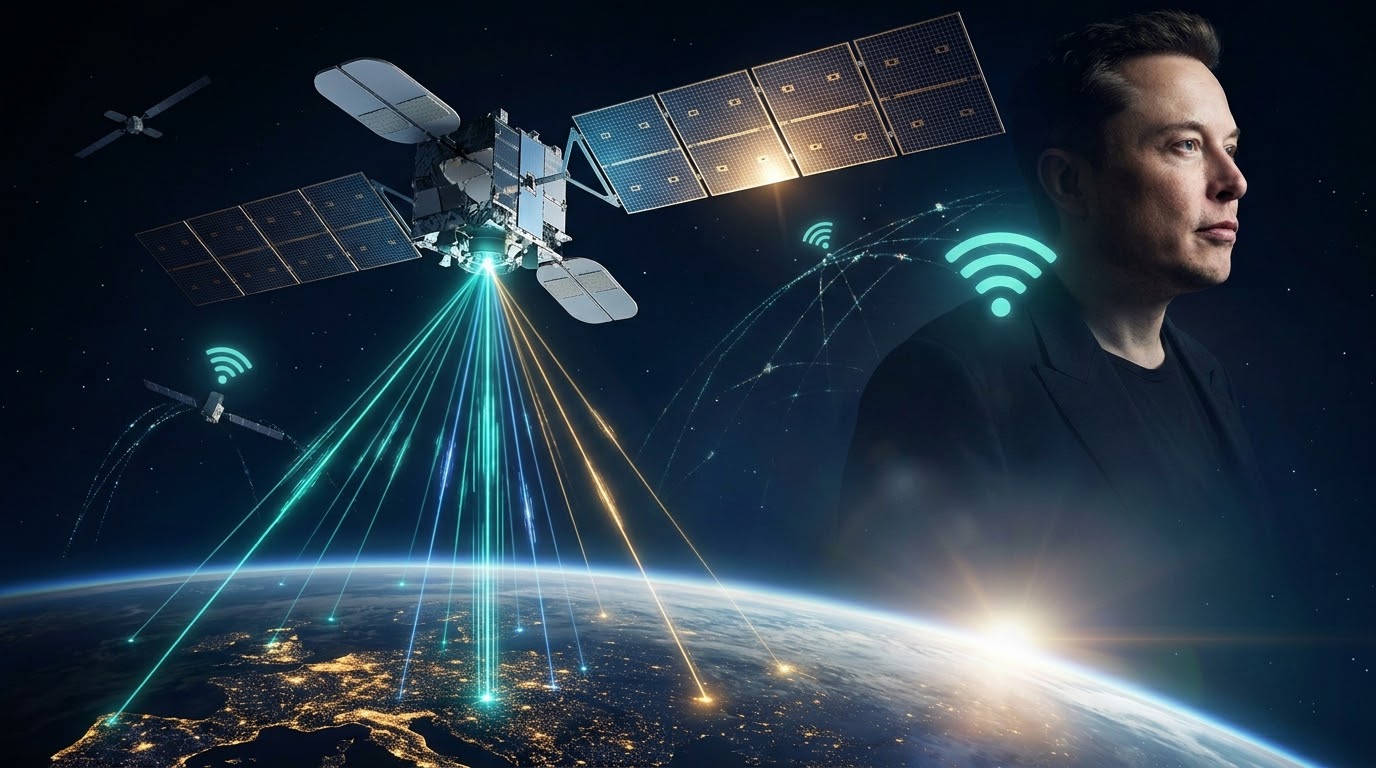
Elon Musk’s SpaceX is making its bid to become the fourth major nationwide mobile carrier in the United States, taking on AT&T, Verizon, and T-Mobile by blending low Earth orbit satellites directly with ground-level spectrum.
From Roaming Partner to Standalone Carrier
For years, SpaceX positioned Starlink’s Direct-to-Cell capabilities as a wholesale complement to traditional telecom operators, most visibly through its early partnership with T-Mobile to eliminate rural dead zones.
That dynamic has fundamentally shifted. SpaceX formally signaled that it will not remain a secondary backhaul service, but intends to operate Starlink Mobile as a full-fledged competitor in the mobile ecosystem.
The $8 Billion Spectrum Acquisition
Satellite signals face physical constraints: high frequency beams often degrade when passing through roofs, exterior walls, and dense foliage. To overcome this hurdle, SpaceX entered an agreement to acquire nationwide low-band cellular spectrum licenses from Grain Management in a transaction valued near $8 billion.
- The 800 MHz Layer: The deal covers paired spectrum in the 800 MHz band. Because low frequencies propagate through solid structures and cover vast distances, this gives Starlink the penetration required for reliable indoor coverage.
- No Specialized Hardware Required: Standard consumer smartphones already support the 800 MHz band natively, meaning subscribers do not need proprietary satellite handsets.
- Layered Architecture: SpaceX plans to combine this low-band indoor layer with its previously acquired 2 GHz mid-band licenses (from EchoStar) for throughput capacity, tied together with its next-generation Starlink V2 constellation.
A Hybrid Network Blueprint
Building a traditional terrestrial network across North America historically costs upwards of $100 billion in land leases, fiber backhaul, and macro towers. SpaceX’s approach cuts that capital outlay:
| Component | Function |
| Starlink V2 Constellation | Orbital coverage delivering direct-to-phone data in rural regions and open corridors. |
| 800 MHz Airwaves | Deep signal penetration through walls, dense urban streetscapes, and moving vehicles. |
| Decentralized Ground Hubs | Integrating micro-cellular nodes with existing Starlink dish installations to reinforce local capacity. |
Telecom Skepticism and Regulatory Hurdles
Incumbent telecom executives have pushed back on the economic and technical viability of the plan. AT&T CEO John Stankey publicly characterized the concept as unviable, noting that matching the multi-gigabit densities of urban fiber and macro tower grids using satellite-anchored infrastructure would still face severe capacity choke points. Additionally, deploying distributed mini-cells at scale raises local zoning questions, property rights constraints, and signal spillover liabilities.
The decisive hurdle remains the Federal Communications Commission (FCC). While regulators have cleared paths for expanding direct-to-cell frequencies, SpaceX still requires formal transfer approval for the 800 MHz licenses and final sign-offs on widespread commercial operation.
If approved, the move positions Musk’s aerospace firm to mount the most serious structural challenge to the American wireless oligopoly in decades.