

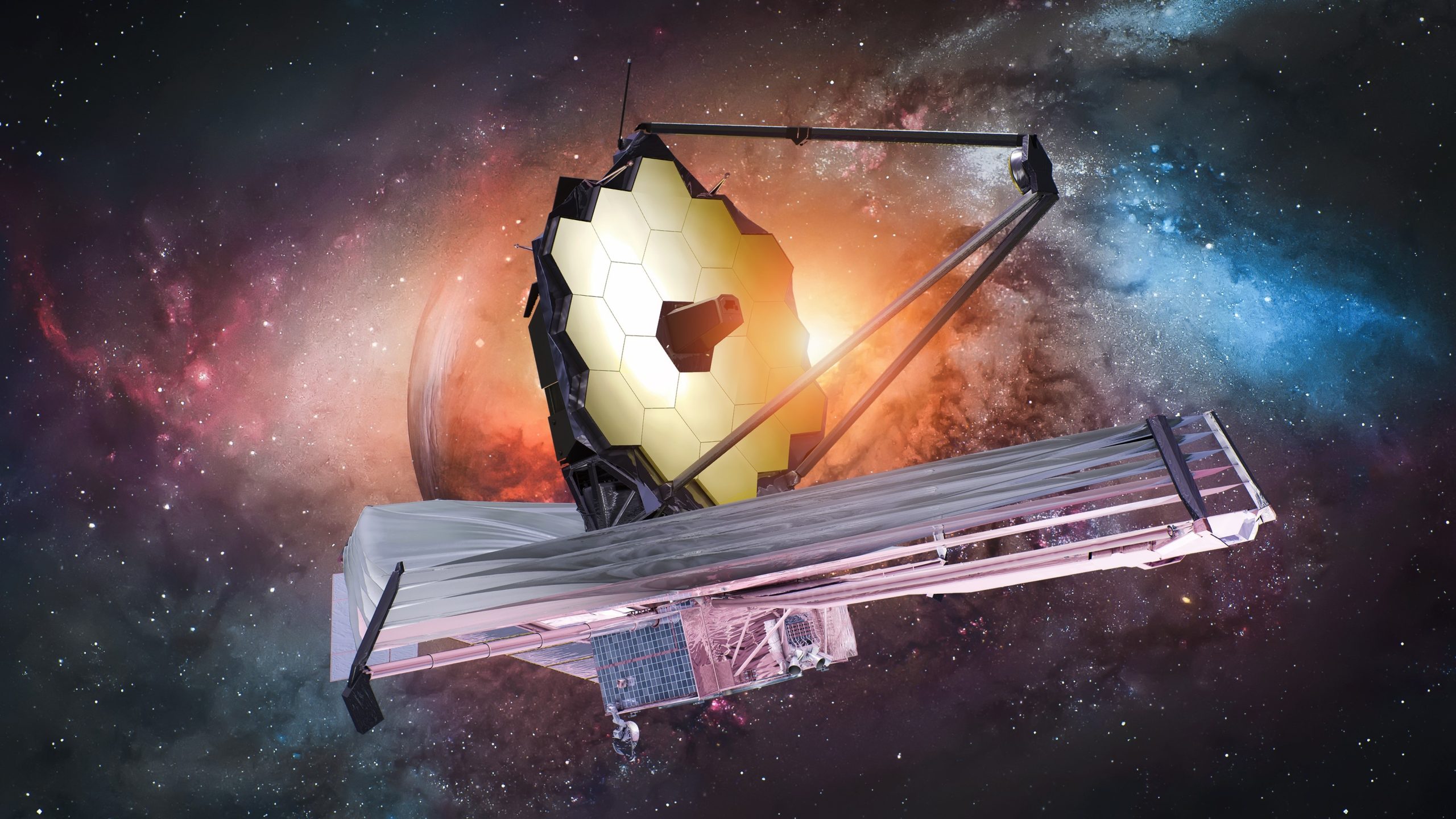
For decades, the search for extrasolar planets focused entirely on detection: confirming that distant pinpricks of light were periodically dimmed by worlds orbiting around them. Today, astrophysics is undergoing a profound paradigm shift. Rather than simply cataloging planets hundreds of light-years away, astronomers can now chemically profile their skies.
Using the high-precision infrared instruments aboard the James Webb Space Telescope (JWST), researchers are decoding atmospheric signatures across the galaxy, confirming the presence of water vapor, carbon compounds, and cloud layers across worlds humanity will never physically reach.
The Mechanics of Transmission Spectroscopy
Analyzing the atmosphere of an object trillions of miles away sounds like science fiction, but the underlying methodology relies on a bedrock astronomical technique known as transmission spectroscopy.
The process begins during a transit event:
- Starlight Infiltration: An exoplanet crosses directly between its host star and the space telescope’s mirrors.
- Filtering Through the Limb: While the planet’s solid or gaseous body blocks starlight entirely, a fraction of that stellar light filters directly through the planet’s thin atmospheric outer envelope.
- Wavelength Absorption: Molecules within the atmosphere, such as water (H_2O), methane (CH_4), carbon dioxide (CO_2), and sulfur dioxide (SO_2), absorb precise wavelengths of infrared radiation.
- The Molecular Barcode: By comparing the star’s light profile when the planet is in front of it versus when it is not, scientists isolate the light absorbed exclusively by the atmosphere. What remains is a transmission spectrum: a chemical fingerprint of an alien sky.
Moving Beyond Gas Giants
The majority of exoplanetary atmospheres characterized thus far belong to massive gas giants (“hot Jupiters”) or intermediate worlds known as sub-Neptunes. These planets are ideal testing grounds because their puffed-up, high-temperature atmospheres generate large, clear signals against their host stars’ light curves.
Every observation of a gas giant acts as an instrument calibration test. Each dataset sharpens analytical models, tests noise-filtering algorithms, and confirms the telescope’s spectral resolution limits.
The ultimate benchmark, however, is not the gas giants.
The primary prize in modern observational astronomy is the chemical profiling of smaller, cooler, rocky worlds, particularly those situated in the habitable zones of red dwarf stars, such as the TRAPPIST-1 system. Detecting a stable atmosphere around a terrestrial world requires orders-of-magnitude greater precision than measuring a gas giant, as terrestrial atmospheres are comparatively razor-thin.
The Road to Biosignatures
As spectroscopic instruments continue to refine observational limits, astronomers are drawing closer to answering whether rocky exoplanets possess secondary atmospheres capable of sustaining liquid water.
Should the observatory identify chemical imbalances, such as combinations of methane and oxygen that typically degrade rapidly without a continuous biological or complex geological source, humanity may face its first evidence of a living atmosphere. Webb’s observations make one fact increasingly clear: humanity is no longer restricted to asking if other planets exist, but what those worlds are made of.