

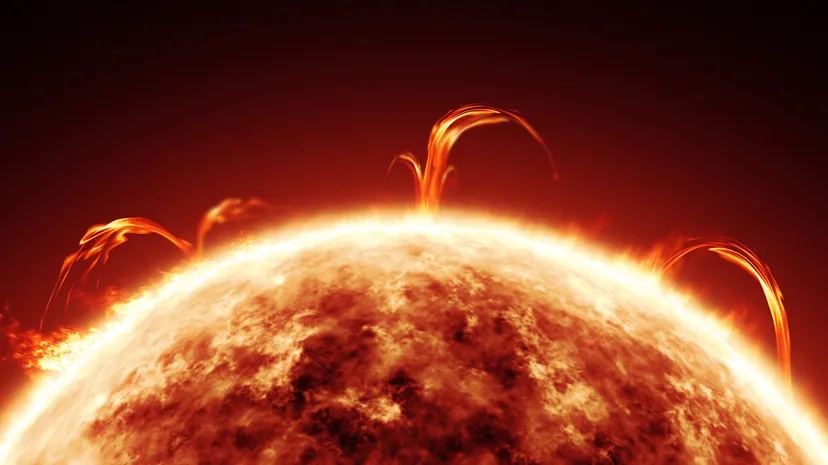
When most people check the daily forecast, they look for rain, snow, or rising temperatures. But 93 million miles away, an entirely different kind of weather is constantly brewing. Solar flares, coronal mass ejections (CMEs), and high-speed solar winds routinely buffet Earth’s magnetosphere.
To safeguard our technologically dependent society, the Space Weather Prediction Center (SWPC) division of the National Oceanic and Atmospheric Administration (NOAA) and the National Weather Service (NWS) operates a 24/7 monitoring and notification system modeled directly on terrestrial severe storm forecasting.
The Warning Framework: Watches, Warnings, and Alerts
Much like tracking a severe thunderstorm or hurricane, SWPC uses a tiered bulletin system to communicate risk as solar phenomena evolve from initial eruptions to planetary impacts:
- Watch: Issued when conditions are favorable for a space weather event to develop. Watches typically provide lead times ranging from several hours to a few days, such as when a CME is observed leaving the Sun and models project it on a collision course with Earth.
- Warning: Issued when a space weather event is imminent or already occurring at lower thresholds and expected to intensify. Warnings require rapid operational awareness from power grids, satellite operators, and aviation dispatchers.
- Alert: Issued when observed space weather thresholds are actively met or exceeded (e.g., real-time detection of high-energy proton fluxes or strong geomagnetic fluctuations detected by ground magnetometers).
The NOAA Space Weather Scales
SWPC communicates the severity of these events using three primary indices, each rated from 1 (Minor) to 5 (Extreme):
| Scale | Phenomenon | Primary Driver | Key Terrestrial Impacts |
| R (Radio Blackouts) | High-frequency (HF) radio degradation | Solar Flares (X-ray emissions) | Disrupts maritime, military, and commercial aviation communications on Earth’s sunlit side. |
| S (Solar Radiation Storms) | Elevated energetic proton counts | Energetic solar particle events | Poses biological radiation hazards to astronauts/high-altitude flyers; blinds optical satellite sensors. |
| G (Geomagnetic Storms) | Magnetic field disturbances | Coronal Mass Ejections & Solar Wind | Induces geomagnetically induced currents (GICs) in power grids; degrades GPS accuracy; triggers vivid auroras. |
Why Space Weather Bulletins Matter
While space weather rarely poses direct physical threats to human life on the surface, thanks to the protective shielding of Earth’s atmosphere and magnetic field, modern infrastructure is acutely vulnerable:
- Power Grids: Geomagnetically induced currents can saturate bulk power transformers, triggering protective trips, voltage collapse, or permanent hardware damage.
- Global Navigation Satellite Systems (GNSS / GPS): Sudden ionospheric fluctuations cause signal delay and scintillation, degrading positioning accuracy for navigation, automated farming, and surveying.
- Aviation and High-Frequency Radio: Transpolar flights must reroute away from polar regions during radiation storms to avoid communication blackouts and minimize crew/passenger radiation exposure.
- Orbital Operations & Satellite Drag: Solar activity warms and expands the upper atmosphere, increasing atmospheric drag on low-Earth-orbit satellites and requiring orbit-raising maneuvers or collision avoidance adjustments.
By providing publicly accessible JSON data streams, subscription-based notifications, and real-time dashboards, NOAA’s SWPC ensures that government agencies, utility operators, and commercial industries can take preemptive action before space weather hits home.