

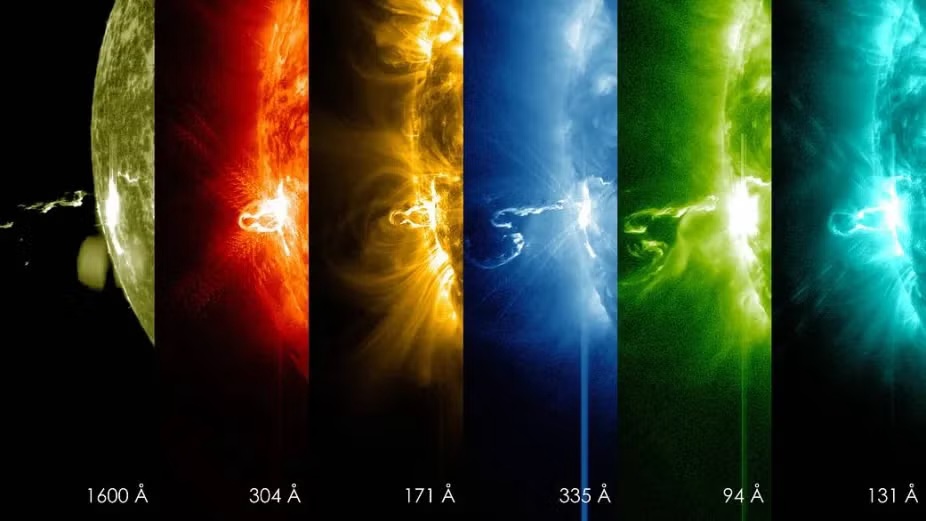
Space weather forecasters are closely tracking a pair of coronal mass ejections (CMEs) hurtling across the inner solar system toward Earth, following back-to-back moderate solar flares. If the Sun maintains its current level of eruptive activity, scientists warn that our planet could face a rapid-fire “train” of plasma storms capable of rattling Earth’s geomagnetic field.
Back-to-Back Flares: Breaking Down the Blasts
The activity stems from two separate M-class solar flares—rated at M1.4 and M1.9, respectively.
- The M1.4 Flare & Strong Shockwave: Despite carrying a slightly lower peak X-ray classification than its sibling, the M1.4 eruption unleashed a prominent, highly visible coronal shockwave rippling through the solar atmosphere. These supersonic shockwaves (often detected as coronal waves or solar tsunami-like disturbances) signal rapid coronal displacement, propelling a dense, well-defined cloud of magnetized plasma outward.
- The M1.9 Flare: While registering marginally higher on standard satellite X-ray detectors, the subsequent M1.9 flare produced a noticeably weaker shock signature and a more diffuse eruptive blast.
In space weather monitoring, flare peak intensity alone does not always determine CME severity. The kinematic speed, magnetic orientation, and density of the ejected material dictate how strongly a CME will impact interplanetary space.
The “Plasma Train” Risk: Cannibal CMEs and Compounding Impacts
When multiple CMEs launch within hours or days along similar Earth-directed trajectories, they often interact before reaching our magnetosphere:
- Pre-conditioned Interplanetary Space: The initial CME sweeps away ambient solar wind, clearing a low-density corridor behind it.
- Accelerated Trailing Storms: Subsequent plasma clouds encounter less resistance, allowing faster trailing eruptions to catch up to slower preceding ones.
- Compound Shock Fronts: If multiple storms merge in transit—a process known as a “cannibal CME”—their magnetic fields compress. This interaction can amplify geomagnetic disturbances far beyond what either individual M-class eruption would cause alone.
If current eruptive regions on the Sun remain volatile and release additional CMEs in rapid succession, Earth will experience sustained pressure on its magnetosphere rather than a single, isolated impact.
What to Expect on Earth
| Potential Impact Area | Expected Severity & Manifestations |
|---|---|
| Aurora Displays | High-latitude auroral activity (Northern and Southern Lights) is likely to expand equatorward if the trailing shocks create prolonged southward magnetic fields (B_z). |
| Radio & Communications | Brief High-Frequency (HF) radio degradation across the sunlit side of Earth during flare peaks, accompanied by possible satellite communication jitter during CME arrival. |
| Satellite Operations | Modest increases in upper-atmosphere drag for low-Earth orbit satellites as solar radiation heats and expands the thermosphere. |
| Power Infrastructure | Low risk for catastrophic grid disruption, though grid operators monitor geomagnetically induced currents (GICs) during extended compound storms. |
Forecasters at NOAA’s Space Weather Prediction Center (SWPC) and ESA’s Space Safety Programme are running coronagraph telemetry through numerical ENLIL solar wind models to calculate precise arrival times, shock velocities, and geomagnetic disturbance indices (Kp levels). Observers at mid-to-high latitudes should keep watch for enhanced night-sky auroral activity once the primary shockwave crosses the L1 monitoring point.