

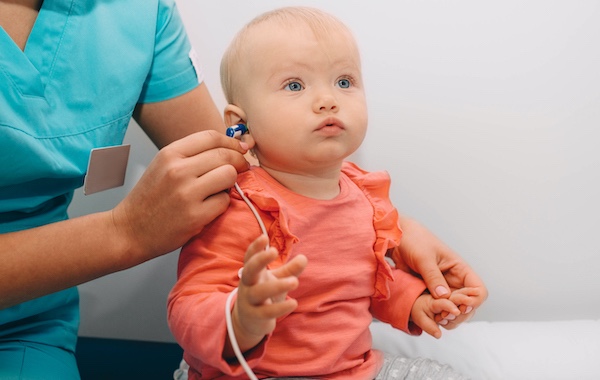
A child sits in a testing room with a pair of headphones clamped over their ears. A speaker produces a low-volume chime. For years, tests like this returned a flatline, zero recognition, zero response. Then, the child flinches, turns their head toward the sound, and grins.
In clinical trials across the globe, from Fudan University in Shanghai to the Children’s Hospital of Philadelphia, children born completely deaf due to a rare genetic defect are beginning to hear. They aren’t relying on the robotic, digitized frequencies delivered by cochlear implants. Instead, they are experiencing biological hearing, made possible by a harmless modified virus engineered to fix broken genetic code directly inside the inner ear.
This is the frontier of sensory gene therapy: an intervention that repairs the cellular circuitry of sound before it leaves the ear.
The Molecular Jam: What Is Otoferlin?
To understand how the treatment works, look at how an ear translates sound waves into conscious thought.
Vibrations in the air travel down the ear canal, ripple through the fluid of the cochlea, and deflect microscopic hair cells. When inner hair cells sway, an influx of calcium triggers the release of neurotransmitters across a microscopic gap to the auditory nerve.
In children born with autosomal recessive deafness 9 (DFNB9), that entire acoustic machine is intact, except for a single faulty component.
A mutation in the OTOF gene prevents inner hair cells from producing otoferlin, a specialized protein that acts like a rapid-fire vesicular courier. Without otoferlin, the hair cells sense incoming sound waves, but they cannot dump neurotransmitters across the synapse. The auditory nerve waits in permanent silence for a message that never arrives.
The Trojan Horse with a Cargo Problem
The fix sounds deceptively simple on paper: provide hair cells with a functional copy of the OTOF gene. In practice, molecular biologists ran straight into a biophysical bottleneck.
Doctors use adeno-associated viruses (AAVs) to shuttle corrective DNA into human tissue. AAVs are naturally non-pathogenic and highly efficient at entering human cells without causing disease. But AAVs are tiny, with a rigid capsid capacity of roughly 4.7 kilobases of genetic material.
The OTOF gene is massive, roughly 6 kilobases long. Trying to stuff an intact OTOF sequence into a single AAV vector is like trying to force a queen mattress into the trunk of a compact sedan.
To solve the puzzle, researchers engineered a dual-AAV delivery system:
- The OTOF gene is split into two halves: an N-terminal sequence and a C-terminal sequence.
- Each half is packaged into a separate viral carrier equipped with overlapping splice sites.
- Surgeons inject the cocktail through the round window membrane of the cochlea, directly into the fluid of the inner ear.
- Once both viruses penetrate an inner hair cell, the cell’s natural DNA-repair and recombination mechanisms stitch the two halves together, synthesizing the full-length otoferlin protein.
From Decibels to First Words
Within weeks of receiving the infusion, children who had never registered the sound of a closing door or running water began turning their heads toward whispers and recognizing their parents’ voices.
The success of OTOF gene therapy serves as a functional proof-of-concept for the entire field of neurotology. While otoferlin deficiency accounts for a small fraction of congenital deafness, hundreds of other genetic mutations cause sensory deficits worldwide. Proving that split-vector AAVs can safely reconstruct complex machinery inside a fragile organ like the cochlea opens the door to treating broader forms of hereditary hearing loss, retinitis pigmentosa, and neuromuscular conditions.
For the young patients in these trials, the victory isn’t theoretical. It is the sudden, welcome intrusion of a loud, chaotic world, measured in footsteps, laughter, and the steady cadence of their own names.